

Plant Imperialists : The destructive case of Lantana camara
British gardening enthusiasts brought Lantana camara, a shrubby plant with spectacular inflorescence, to Kolkata around the 1800s. Surely, they enjoyed having colourful flowers around them and hoped to feel less homesick while they mass-occupied Indian land

Little did they know that this act of beautifying their garden spaces with a plant that originated from the American tropics would cause a widespread effect on the environment across the Indian subcontinent. And as they colonised the length and breadth of the country through their numerous cantonments, they carried with them their imperialist plant associates. Today, there are hundreds of scientists studying the invasiveness of Lantana; some of who are undoing the damage and others, who are convinced that the plant has won the battle but are developing strategies for adaptive management.
Now you may ask yourself; what makes Lantana so invasive, compared to the numerous other foreign species we see around us? To answer this, we must first understand what an invasive species is, and how it works!
An invasive species is a non-native group of organisms that out-competes native species and is likely to cause environmental and economic harm. Invasion starts with the propagule, which is any living material that can reproduce; like seeds, spores or even a truckload of exotic deer for the rich to hunt. The larger the propagule size is, the greater the propagule pressure, which is the measure of the quantity, quality, and the consistency of these newly introduced propagules. High propagule pressure significantly increases the chances of successful establishment that occurs when the species is able to survive, reproduce, and sustain a population in the new environment. Once established, an invasive species can outcompete native ones due to a lack of natural predators and diseases, or an abundance of propagators in its new home. The consequences of disrupting the ecological balance can be slow but irreversible since there are numerous classes of organisms that interact with the diversity of plants in an ecosystem.
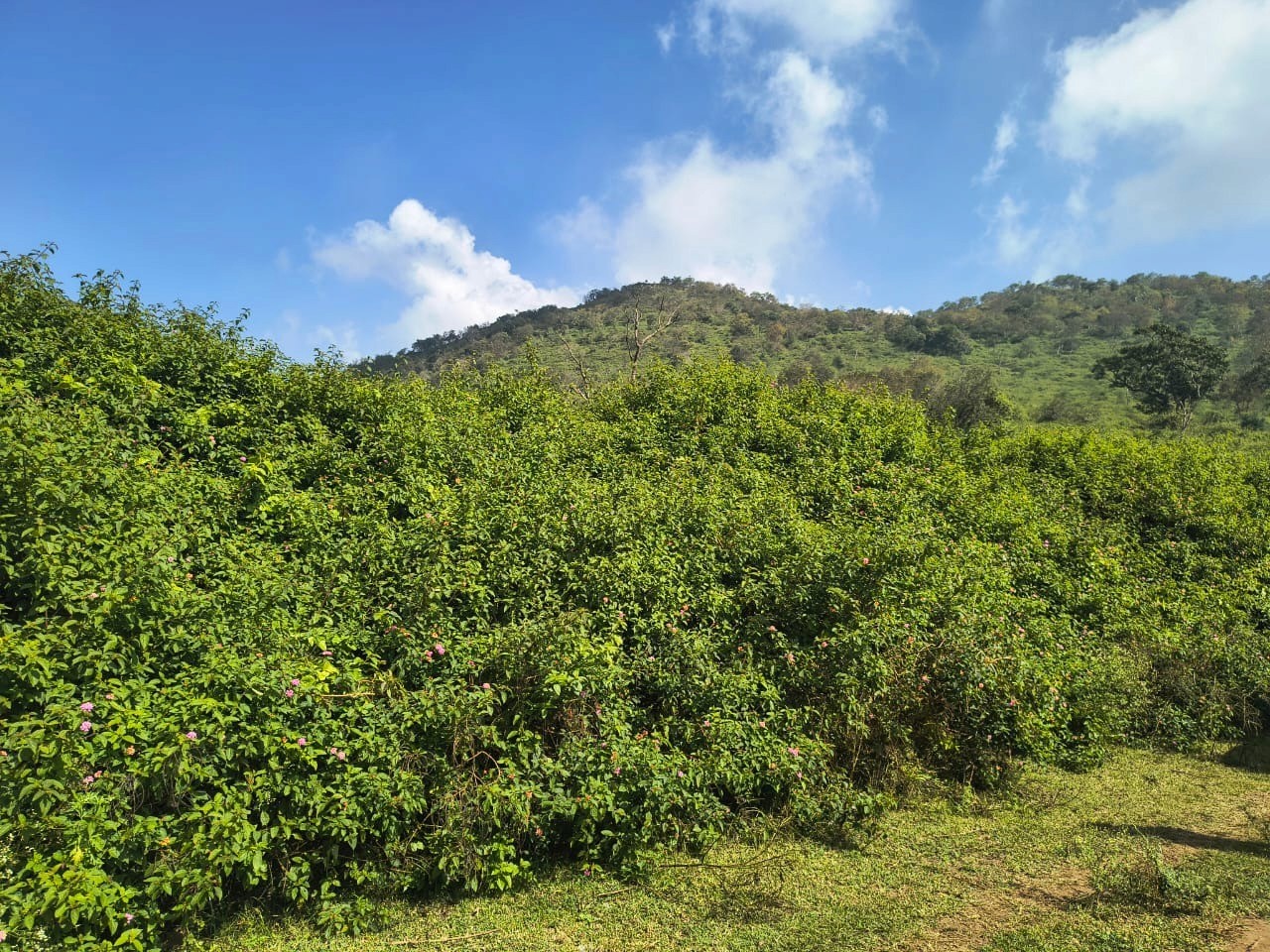
Lantana camara dominates the local plant community and is listed in the IUCN’s “100 of the world’s worst invasive species”
Credits: Naveen . M
The Lantana thrives in the Indian sub-continent because the shrub produces a massive amount of small, fleshy fruits, almost perennially in warm conditions. These fruits are readily consumed by many birds and small mammals, who then excrete the seeds over vast distances. This is a highly effective dispersal mechanism, especially in disturbed or fragmented habitats. Furthermore, Lantana can also spread asexually by layering, where its stems touch the ground and take root, quickly forming dense, impenetrable thickets.
The plant releases toxic biochemicals called allelochemicals, from its leaves, roots, and decaying litter into the soil. These chemicals inhibit the germination and growth of competing native plant species and their seedlings, effectively clearing the understory for itself and forming a monoculture. Irreversible changes in soil chemistry caused by Lantana severely hinder native vegetation recovery, making the problem difficult for biodiversity scientists
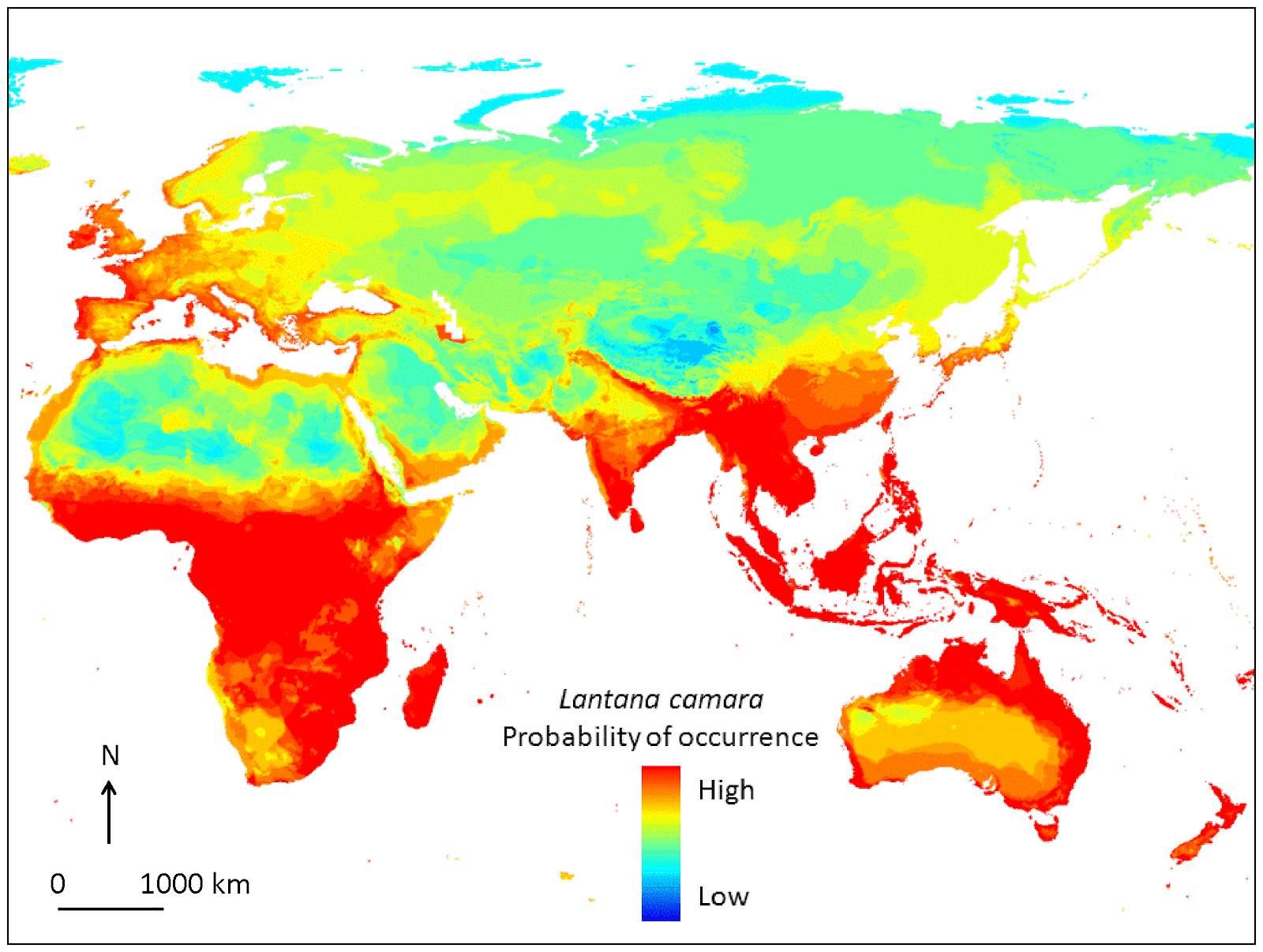
The regions where there is a high likelihood of finding populations of Lantana species across Asia, Africa and Austranesia. The regions that are coloured red also happen to be significant adobes for biodiversity.
Source: https://doi.org/10.1371/journal.pone.0032407.g004
Numerous efforts have been made to manage Lantana infestations in various Indian ecosystems. Successful and cost-effective strategies for managing the invasive shrub have been tried in Indian Tiger Reserves. One approach focuses on removing mature plants using the cut rootstock method (uprooting the main tap root of the plant). Another method involves identifying perch sites of generalist birds that propagate seedlings of lantana, in order to locate saplings under these perch sites. Moreover, many furniture producers and artists are creating products made from Lantana.
It is important for gardeners as well as agriculturists, to understand the nature of invasive species. Ornamentals and exotic plants can be grown, although it needs to be looked after with care by botanists and ecologists who can create controlled environments for them, like botanical parks! And maybe a native garden wouldn’t be as colourful as a Victorian one, but they’re much more environmentally friendly.
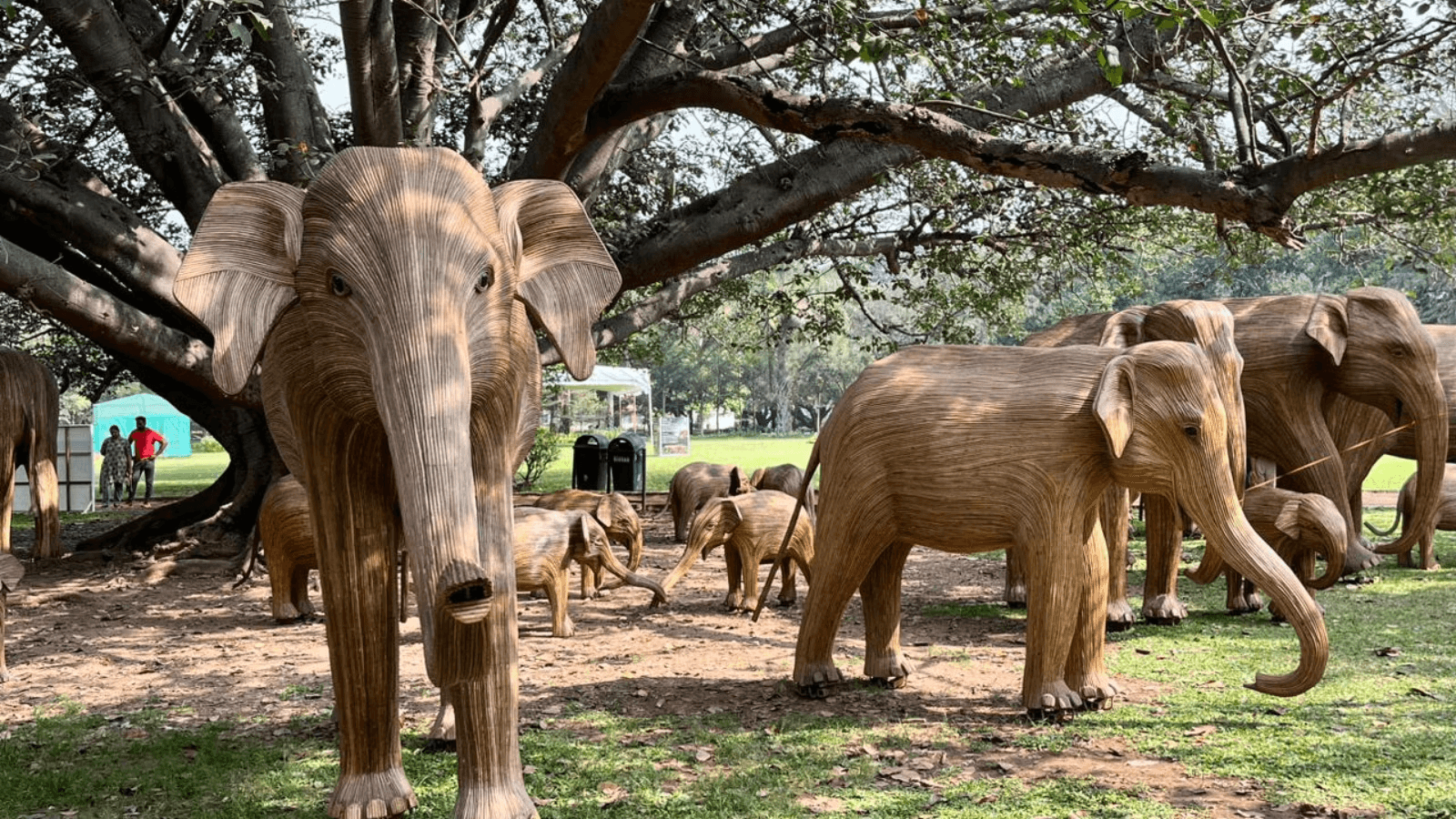
Lantana elephants made for the “Man-Animal Conflict Exhibition.

Furniture made out of uprooted Lantanas by Lantana Craft Centre.
Source:https://indianexpress.com/article/cities/bangalore/100-lantana-elephants-man-animal-conflict-long-exhibition-kicks-off-9142625/, https://lantanacrafts.org/lcc_products.php
Author :
Vinay Kolekar
LinkedIn I Instagram
Acting Locally for Global Impact: Reimagining PBRs by Integrating Ecosystem Services
The theme of the International Day for Biological Diversity 2026—“Acting locally for global impact”—is a powerful reminder that global ecological security relies fundamentally on local ecosystems.
Read more
International Day of Forests 2026
Forests are not just natural assets - they are economic lifelines and knowledge systems. Nurturing them is essential for a sustainable and prosperous future for people and planet
Read more
World Wildlife Day 2026
The University of Transdisciplinary Health Sciences and Technology (TDU) Calls for Action to Conserve Medicinal and Aromatic Plants for Health, Heritage and Livelihoods
Read more
Wetlands, Traditional Knowledge and Health : A TDU - FRLHT Perspective
Wetlands are dynamic ecosystems where water meets land, creating rich habitats that support biodiversity, water security, climate resilience and cultural heritage. Observed annually on 2 February, World Wetlands Day commemorates the adoption of the Ramsar Convention (1971) and underscores the essential role wetlands play for both nature and people worldwide.
Read more

International Environmental Education Day (January 26)
On International Environmental Education Day (January 26), we are reminded of a powerful truth: The future of our planet depends on what and how we teach today.
Read more

TDU VC Darshan Shankar pays tribute to Prof. Madhav Gadgil
Read more
