

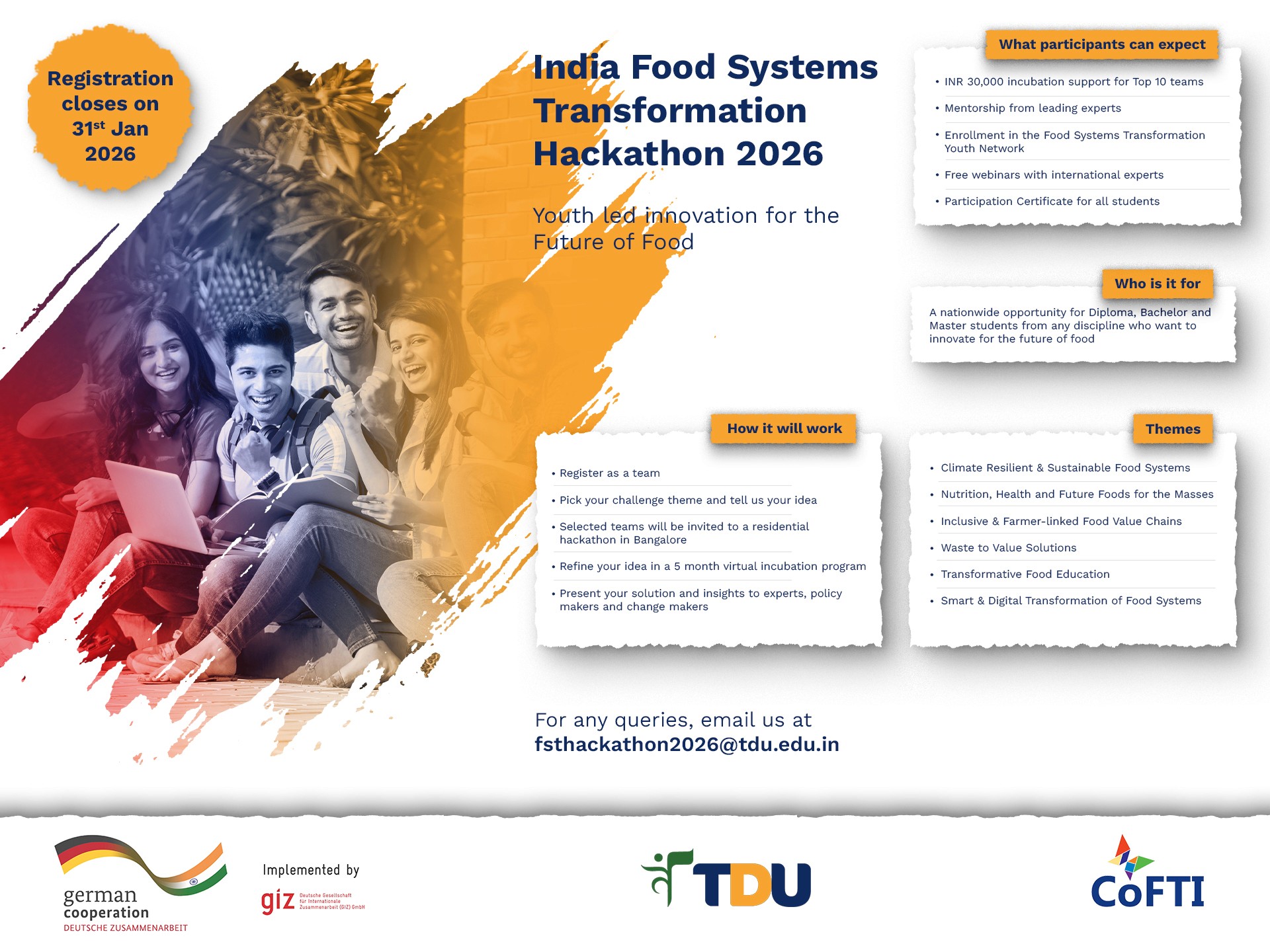
India Food Systems Transformation Hackathon 2026
Youth led Innovation for the Future of Food
Background
India’s food systems stand at a critical crossroads. Climate risks, nutrition insecurity, ecological degradation, rural distress and the rise of ultra-processed diets demand bold, future-ready solutions. Today’s youth will inherit these challenges and will also shape the future.
The Food Systems Transformation Hackathon 2026 encourages university students across India to become next-generation changemakers. Through challenge-based learning, interdisciplinary teamwork, mentorship and immersive experiences, participants will explore innovative pathways to create sustainable, inclusive and health-promoting food systems for the future.
Objectives
● Encourage students to research real-world food system challenges
● Inspire creative, practical, ecological and scalable solutions
● Build problem-solving, analytical and leadership capacities among youth
● Catalyse experimentation, innovation and entrepreneurship in food systems
● Strengthen a national network of young food system thinkers and innovators
Hackathon Overview
● Duration: December 2025 – August 2026
● Eligibility: Students across India, currently enrolled in Diploma, Bachelor and Master programs in any discipline
● Teams: 3–4 students from the same or different institution
● Themes: 6 Food Systems Challenges | food systems transformation Youth Network
● Outcome: Innovation ideas | Incubation | Pathways to implementation
● Support: Mentoring | Workshops | Incubation funding
● Selection: 10 teams will be selected for hackathon and a 5 month incubation program
● Mode: Hybrid - online + 2 day in-person event in Bangalore for selected teams
Apply Now
👉 Click Here to Submit Your Idea
Themes and Areas of Exploration
1. Climate Resilient & Sustainable Food Systems
Focus :
Transformative food production systems that dramatically reduce ecological strain and climate stress
Challenge areas :
● Climate resilient agriculture using advanced tech like AI, genome editing, microbiome, bio stimulants to transform fields into carbon sinks
● Alternate Agri-systems such as agroecology, hydroponics, permaculture, food forests and other climate-resilient food ecosystems
● Precision fermentation to deliver low environment footprint food ingredients such as dairy proteins, protein-based sweeteners, dietary fibers, cultured meat
● Water-efficient and energy-smart methods of food processing
● Scalable urban farming ideas
Why it matters : Climate volatility directly affects supply chains, costs and food security. This theme invites solutions that transform food systems and future-proof ‘food’
2. Nutrition, Health and Future Foods for the Masses
Focus :
Align food systems with evolving nutrition and health needs
Challenge areas :
● Affordable nutritious foods and diet diversity for children, women and elderly
● Addressing malnutrition through novel formulations and emerging technologies such as biofortification
● Smart proteins and functional foods to reduce pressure on conventional agriculture while improving nutrition access
● Clean labels, functional foods and personalized nutrition solutions
● New models that leverage frontline health workers, strengthen nutrition literacy and influence healthier community food choices, with a focus on rural & tribal populations, children, women and senior citizens
● Food innovations that can multi-fold enhance the effectiveness of large-scale public programs like PM Poshan and Anemia Mukt Bharat to improve micronutrient outcomes
● Innovations in the informal food sector, such as street food, to create safer and nutritious options for consumers while also providing livelihoods
Why it matters : Food systems must not only feed populations but also improve health outcomes and meet changing consumer needs and expectations
3. Inclusive & Farmer-linked Food Value Chains
Focus :
Strengthening livelihoods and equity across food value chains
Food systems must revitalize rural economies by engaging farmer communities, food producer organizations, women self-help groups to create inclusive, sustainable economic growth and develop resilience
Challenge areas :
● Food systems that enable rural entrepreneurs to scale sustainable food-based businesses, reduce post-harvest losses, improve market access and provide fair pricing
● Aggregation, logistics and cold chain solutions to transform FPOs, SHGs and MSMEs and make them key pillars of sustainable food systems
● Local food resources and NUS (neglected and underutilized species) based viable rural enterprises that also deliver dietary diversity besides livelihoods
● Women and youth-led food enterprise innovations
● Innovations that strengthen circular rural economies while preserving cultural and ecological diversity
Why it matters : Inclusive growth ensures that innovation benefits farmers and small processors, not just end consumers
4. Waste to Value Solutions
Focus :
Food loss and waste reflect inefficiencies across production, storage, distribution and consumption. Transforming waste into value through upcycling agri-waste, reducing urban food waste and redesigning systems can build circular, equitable food economies
Challenge areas :
● Valorizing agricultural waste and by-product streams into high-value products at scale
● Innovating urban food waste systems to capture surplus efficiently and redistribute it to underserved populations
● Innovations that address behavioral and/or technological interventions to reduce household and food-service waste without compromising convenience
Why it matters : Minimizing loss, reshaping consumer habits and improving surplus redistribution ensure that food is treated as a valuable resource while supporting sustainability and reducing hunger
5. Transformative food education
Focus :
Transformative food education that equips learners with the knowledge, skills and agency to advance healthy societies and a healthy planet
Challenge areas:
● Innovative experiential learning programs using immersive technologies, gamification to reshape young people’s understanding of sustainable food systems
● Educational models empowering students to influence family and community dietary behavior
● Leveraging new technologies (AI, virtual reality, augmented reality, etc) to transform school education to integrate local food traditions with science-based nutrition and sustainability principles
Why it matters: By shaping youth as conscious consumers and change-makers, it fosters long-term shifts in dietary habits, environmental stewardship and community wellbeing
6. Smart & Digital Transformation of Food Systems
Focus :
Step change in efficiency, transparency and decision-making in food systems
Challenge areas:
● AI, IoT, block chain for quality control, traceability, shelf-life prediction
● Carbon footprint tracking and reduction in farms, food industries and at consumer use
● Digital platforms for farmer–processor–retailer integration
● Blockchain for food safety, authenticity and exports
● Predictive analytics for demand, pricing and inventory
Why it matters: Digital tools can dramatically reduce losses, enhance trust, boost competitiveness
Evaluation Criteria
Solutions will be assessed on:
● Innovative: Creative, thoughtful, non–quick-fix ideas
● Relevant: Locally grounded, accessible and context-aware
● Scalable: Able to grow sustainably without compromising values
● Replicable: Adaptable across similar contexts
● Equitable: Fair to communities, ecosystems and all life
● Feasible: Realistic with pilot potential
Learning Outcomes
Participants will:
● Understand India’s food systems challenges and opportunities
● Develop interdisciplinary problem-solving skills
● Gain hands-on experience in innovation design
● Receive mentorship from national experts
● Join a national Youth Food Systems Network
● Build prototypes and pitch to experts across academia, industry and policy
Key Dates
● 31 January 2026: Registration and Idea Submission Deadline
● February 2026: Online Presentations and Selection
● March–August 2026: Mentorship and Incubation
● September 2026: Final Presentations
Organizers
GIZ – Deutsche Gesellschaft für Internationale Zusammenarbeit
A German federal enterprise advancing sustainable development globally across more than 120 countries, working on energy, environment, economic development, and peacebuilding.
TDU – The University of Trans-Disciplinary Health Sciences & Technology
A pioneering university integrating Ayurveda, natural sciences and modern technology to promote ecological wellbeing, innovation and sustainable development.
CoFTI – Coalition for Food Systems Transformation in India
A multi-stakeholder alliance convening innovators, policymakers, academics and community leaders to shape sustainable, resilient and equitable food systems across India.
Apply Now
👉 Click Here to Submit Your Idea
📧 For queries: fsthackathon2026@tdu.edu.in
(Please allow 2–3 working days for responses)


Contact us

Official Email
If you have any queries, please feel free to write us a letter. You can mail it to:
info@tdu.edu.in

Official Phone
You can reach us by telephone during working hours, i.e., Monday-Friday between 10:30AM & 4PM IST:
080 2856 8000

Official Address
For all correspondence and official purposes, this is our legal name and address:
